Jean-Luc Mélenchon, l’homme qui avançait à contre-courant
6.6
|2017|83 min200DocumentaryTV Movie
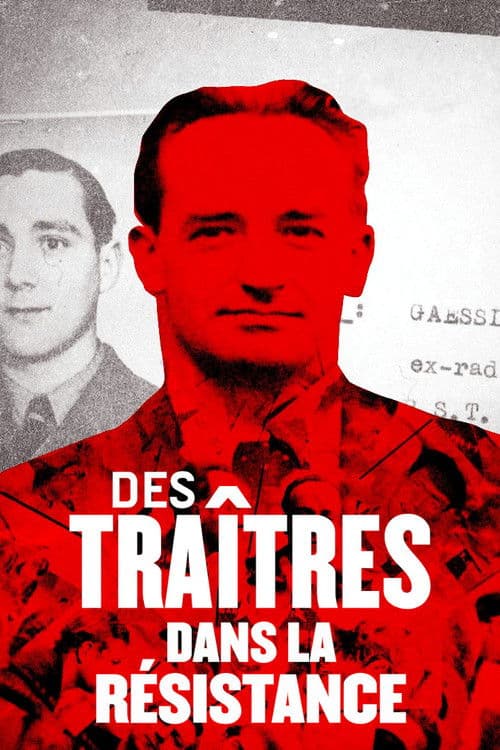
In May 1943, Ernst Kaltenbrunner, the new head of the Reich Central Security Office, gave Hitler a report describing in detail the organization of the French Resistance. Indeed, during the Second World War, most of the Resistance networks had been infiltrated by traitors, the "V Man" (trusted men) in the service of the occupier. The Germans had established treason as a system and recruiting Frenchmen ready to inform on them was one of their priorities. It was these Frenchmen, whose number is estimated at between 20,000 and 30,000, who dealt terrible blows to the Resistance.
Explore NowThe film deals with the process of globalization based on the thought of geographer Milton Santos, who through his ideas and practices, inspires the debate about Brazilian society and the construction of a new world. Santos discusses his views on the importance of respecting difference and his belief that an alternative globalisation model could wholly enfranchise all citizens of the world. An illustrious presence in 20th century social sciences, the man dubbed as ‘geography’s philosopher’ eloquently elucidates a developing world perspective on the global age.
Explore NowThis documentary examines the media's coverage of the Canadian federal election of May 1979. Filmed over a 3-week period, it takes a fascinating look at journalists in action and the politicians who attempt to manipulate the media.
Explore NowThis documentary follows the French soccer team on their way to victory in the 1998 World Cup in France. Stéphane Meunier spent the whole time filming the players, the coach and some other important characters of this victory, giving us a very intimate and nice view of them, as if we were with them.
Explore NowMichael Moore's view on how the Bush administration allegedly used the tragic events on 9/11 to push forward its agenda for unjust wars in Afghanistan and Iraq.
Explore NowA documentary on Al Gore's campaign to make the issue of global warming a recognized problem worldwide.
Explore NowIn January 1961, a new generation in the guise of John F. Kennedy moved into the White House. All of a sudden politics were youthful, dynamic and sexy. During the brief period in which he was in office, the first pop star of politics accompanied America through the darkest days of the Cold War. At the same time, his signal to embark in new directions was eagerly welcomed by younger generations all around the world. Later on, Jackie Kennedy was to compare his presidency with Camelot - the legendary court of King Arthur. Yet, there were also dark sides to this popular president's life.
Explore NowIn 2017, twenty years after the British handed over Hong Kong to China in 1997, young people, more politicized than any previous generation and proud of their land, do not feel Chinese and actively fight against the oligarchs who want to subdue them to China's authoritarian power.
Explore NowA family portrait in which the director profiles his grandmother, Odette Robert. Eustache includes in the film the conditions of its production — he is seated at the table with her, pours her some whiskey, speaks with the camera operator, manipulates the clapboard at the head and tail of the reels, and even takes a phone call. Robert, who was seventy-one, speaks rapidly and tells the story of her life, starting from her early childhood in villages in the Bordeaux region of France. A shorter version of the film ("Odette Robert") was edited in 1980 to be broadcast on television on TF1. The complete film only gained exposure in 2002, when it was salvaged by Boris Eustache, Thierry Lounas, João Bénard da Costa, Jean-Marie Straub, and Pedro Costa.
Explore NowFrom his modest apartment in Lima, a teacher gives virtual classes, seeking to reflect with his young students with low socio-economic backgrounds on racism, politics and inequality: issues that resonate in an increasingly fractured country.
Explore Now