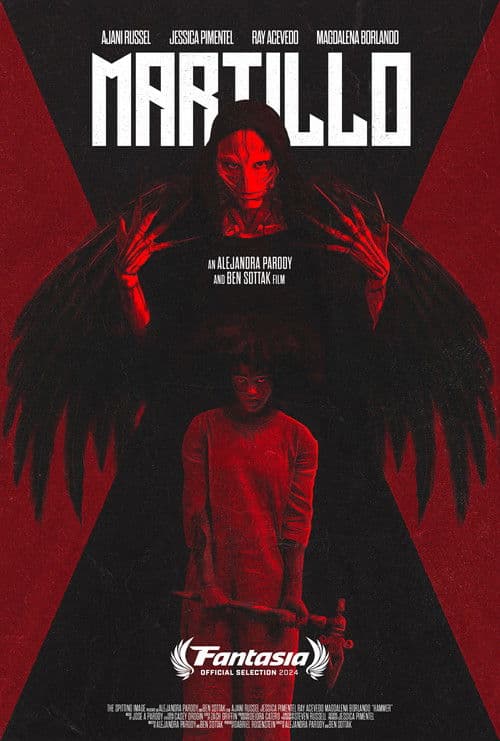
"In 1904, disgusted by the aftermath of the Spanish-American War and the subsequent Philippine-American War, Mark Twain wrote a short anti-war prose poem called "The War Prayer." His family begged him not to publish it, his friends advised him to bury it, and his publisher rejected it, thinking it too inflammatory for the times. Twain agreed, but instructed that it be published after his death, saying famously: None but the dead are permitted to tell the truth."
Cartagena, Colombia – 1666. An enslaved woman accused of witchcraft comes face to face with evil incarnate and a Faustian bargain for her freedom while imprisoned in the bowels of the Palace of the Inquisition.
Explore NowA group of people are standing along the platform of a railway station in La Ciotat, waiting for a train. One is seen coming, at some distance, and eventually stops at the platform. Doors of the railway-cars open and attendants help passengers off and on. Popular legend has it that, when this film was shown, the first-night audience fled the café in terror, fearing being run over by the "approaching" train. This legend has since been identified as promotional embellishment, though there is evidence to suggest that people were astounded at the capabilities of the Lumières' cinématographe.
Explore NowDuring Napoleonic wars, a young idealistic drummer, in search of glory, arrives on the battlefield and discovers the horrors of war.
Explore NowJust after recovering from losing his entire unit in battle, Sgt. Rock leads a special army of commandos against a Nazi secret research base.
Explore NowThe Bokelberg photographic collection brings to life the Paris of the Belle Époque (1871-1914), an exhibition of workshops and stores with extremely beautiful shop windows before which the owners and their employees proudly pose, hiding behind their eyes the secret history of a great era.
Explore NowThe Kabul National Museum, once known as the "face of Afghanistan," was destroyed in 1993. We filmed the most important cultural treasures of the still-intact museum in 1988: ancient Greco-Roman art and antiquitied of Hellenistic civilization, as well as Buddhist sculpture that was said to have mythology--the art of Gandhara, Bamiyan, and Shotorak among them. After the fall of the Democratic Republic of Afghanistan in 1992, some seventy percent of the contents of the museum was destroyed, stolen, or smuggled overseas to Japan and other countries. The movement to return these items is also touched upon. The footage in this video represents that only film documentation of the Kabul Museum ever made.
Explore NowOn a winter morning, a mother goes to waken her son Heinrich; his bed is empty. She leaves her flat to find him. The neighbors' door, with a Star of David painted on it, is ajar, the furnishings in disarray, the family gone. She asks passersby, runs to the police then on to the rail yard. Flashbacks show that Heinrich and the neighbors' son Paul are six years old and best friends. Paul's family's deportation is expected soon; Heinrich's mother tells her son that they're going to Toyland. Heinrich wants to go with them, has a bag packed, and listens for their departure. His mother realizes he's joined them, and her resolve becomes more urgent. Will she arrive in time to save Heinrich?
Explore NowA stubborn VCR technician quits his job at an evolving tech-solutions conglomerate to start his own small business in hopes of making a final stand to stay relevant through the changing times.
Explore NowExperimental filmmaker Rubén Gámez explores the iconography of the maguey plant in Mexican cinematic history.
Explore NowChris Marker and François Reichenbach document the massive anti–Vietnam War protest held in Washington, D.C., on October 21, 1967, where more than 100,000 demonstrators gathered at the Lincoln Memorial before marching on the Pentagon. Filmed amid the crowd, the short captures the tension, idealism, and growing radicalism of the American peace movement.
Explore NowExploring the art of Armenian portraitist Hakob Hovnatanyan, Parajanov revives the culture of Tbilisi of the 19th century.
Explore Now